
http://www.ldsmag.com/index.php?option=com_zine&view=article&id=7767&ac=1
By Darcy A. Kennedy
This is the story of how a large gathering of the descendants of Joseph Smith were brought together for the first time.
Towards the end of 2004 our stake president, Conrad Gottfredson, came to our home to visit. My husband, Michael Kennedy, Sr., and I knew our stake president was a very inspired man and heard how he would call someone or visit with them in their home, day or night following promptings that he was needed.
During this visit my husband, confided in him that he was a third great-grandson of Emma and Joseph, the first of Joseph’s posterity to receive the Melchizedek Priesthood, and had been the President of the Joseph Smith Jr. family since the mid 1980’s. He explained further that he had received a charge from President Gordon B. Hinckley to create opportunities for the posterity of Joseph Smith to be receptive to the teachings of the gospel.
The first impression Michael felt guiding him towards accomplishing this charge was, “If you do not have very many members of your family on this side of the veil who are members of the Church, it is because you do not have very many members of your family on the other side of the veil who are members of the Church; for it is those whose temple work has been completed who can impact the lives of their living posterity so they become receptive to the teachings of the gospel.â€
Shortly after this meeting with President Gottfredson, we had a Joseph Smith Jr. family meeting that consisted of Gracia and Ivor Jones (second great granddaughter of Joseph and Emma), Michael and me. The main topic in this meeting was the request the Church had made to the members of the church, wherever they were, to celebrate Joseph Smith’s 200th birthday. We talked about how, we of all people, Joseph’s own descendants, certainly needed to be contributing to this celebration.
We sadly came to the conclusion that we did not have the resources necessary to accomplish what our hearts desired, to have Joseph’s family gather for a birthday celebration. Yet I remember feeling peaceful as Mike told us we would table our ideas for now and see what the Lord would open up. He was confident the Lord would provide a way. We never realized then what lay before us and the miracles that would shortly begin to take place.
About six months later, our Stake President, President Gottfedson asked us to meet with him. During this meeting, he informed us that he felt the Lord wanted the stake to help us gather the Prophet’s posterity. He asked us to see if they would participate and be part of the upcoming Bicentennial Celebration of Joseph’s 200th Birthday.
We found our hearts beating powerfully in our chests as we were told that members of the stake would like to assist in gathering all the children of Joseph and Emma to the Provo and Salt Lake area. Shocked, Mike asked, “Do you know how extensive this is? We have descendants scattered across the United States and almost a third of Joseph’s posterity live in Australia.
Many of these descendants have hard and trying lives and are so limited in resources they will need assistance to get here.†President Gottfredson simply remarked, “That being the case, the Lord will provide and there will be many who are able and will want to help.†Tears of joy came to our eyes and we had complete faith in our priesthood leader’s inspiration. We realized the Lord had heard our prayers pleading to find a way for the posterity of Joseph to gather and celebrate his birth. It reminded me of the scripture “…and they shall bring thy sons in their arms, and thy daughters shall be carried upon their shoulders.†(1 Nephi 21:22)
Every time I read of the children of Israel, I cannot help but see parallels with our cousins, the children of Joseph and Emma. Nephi says, “Are we not broken off from the house of Israel, and are we not a branch of the house of Israel? And now, the thing which our father meaneth concerning the grafting in of the natural branches through the fullness of the Gentiles, is, that in the latter days, when our seed shall have dwindled in unbelief, yea, for the space of many years, and many generations…and then shall they know and come to the knowledge of their forefathers, and also to the knowledge of the gospel of their Redeemer, which was ministered unto their fathers by him; wherefore, they shall come to the knowledge of their Redeemer and the very points of his doctrine, that they may know how to come unto him and be saved. And then at that day will they not rejoice and give praise unto their everlasting God, their rock and their salvation? Yea, at that day, will they not receive the strength and nourishment from the true vine? Yea, will they not come unto the true fold of God? Behold, I say unto you, Yea; they shall be remembered again among the house of Israel; they shall be grafted in, being a natural branch of the olive tree, into the true olive tree.†(1 Nephi 15:12-16)
Men and women of great faith filled the stake president’s office Sunday after Sunday, week after week as plans and preparations were made that would become the beginning of gathering the Prophet’s family. These preparations were performed under the umbrella of the priesthood. Incredible sacrifices of time and means were given. Even to this day we do not know the magnitude of all that took place.
Like Brother William Berrett‘s observations on the building of the Kirtland Temple, “But courageous as the undertaking was, the remarkable thing was its accomplishment and the manner in which that accomplishment was brought about. No miracle was performed to produce funds. No millionaire endowed it…a monument to cooperation–to the power of a people imbued with a common objective and inspired with a common faith.†(Berrett, The Restored Church, pp.125) And I must add, inspired with a common love of Joseph and Emma and a desire for them to have their children.
Knowing our family to be, for the most part, people who prefer to remain in obscurity, who did not know Joseph at all, who had been taught he was often in prison, who had been through so much pain and felt it was safer to remain unknown; a specially designed invitation was made that its reader would not be able to ignore.
Over 500 of these colorful invitations to Joseph’s 200th Birthday Celebration were made and laid inside the cover of a personally autographed book by Matthew Brown, “Joseph Smith: The Man, The Mission, The Message.†The book with the invitation was mailed to each descendant with faith that all the temple work we performed over the last two decades for the deceased families of the Prophet would enable them to impact the lives of their living posterity, and there would be a great desire to accept the invitation and come to this celebration. And they came, many testifying of impressions and feelings they could not explain but knowing they had to come.
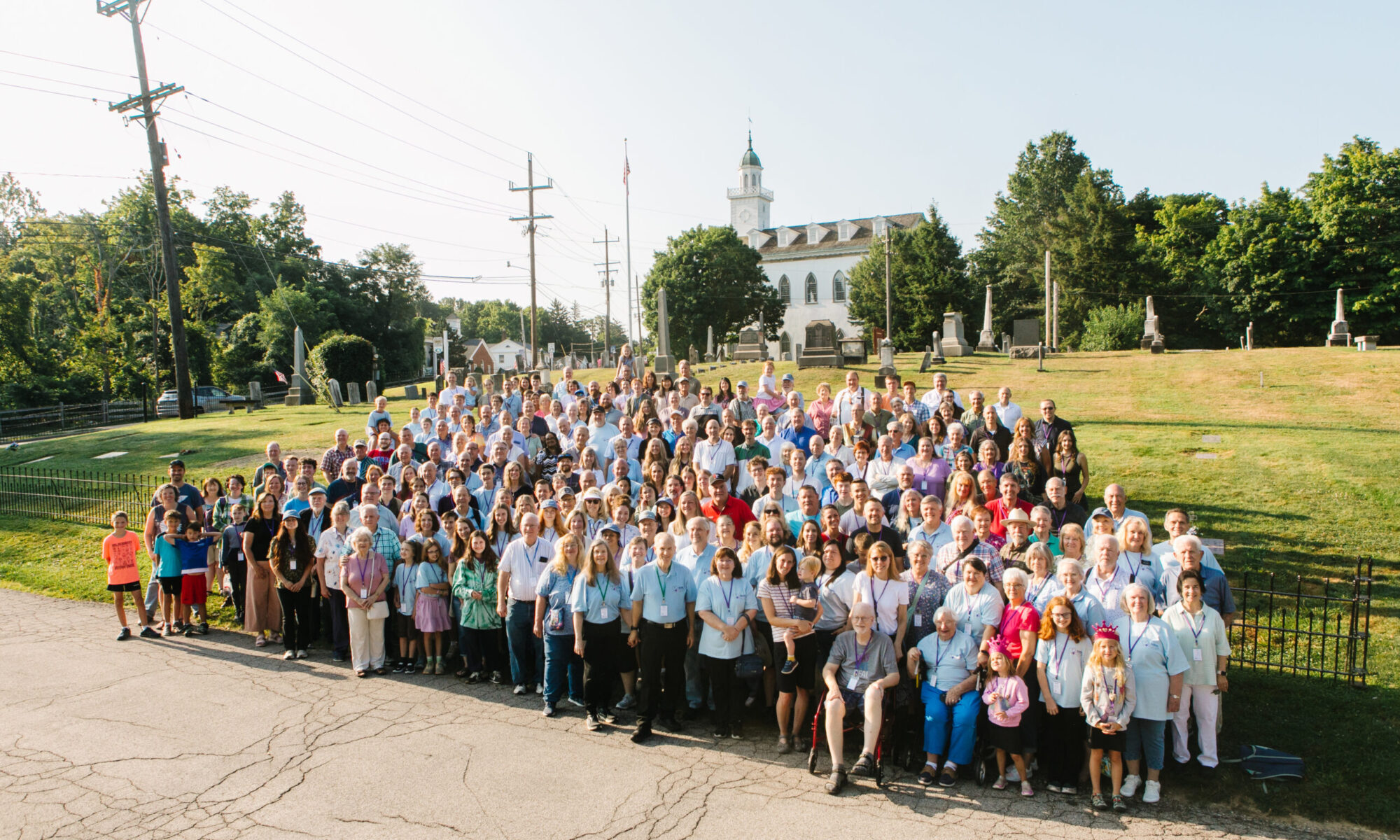
On 5 August 2005 Joseph’s descendants came from all over the United States and even a few from Australia.
We gathered as a big wonderful family in the Joseph Smith Memorial Building in Salt Lake City to enjoy Emma’s oatmeal cookies, using the recipe our cousin, Gracia Jones, found in Emma’s recipes. A fine dinner was served and, state by state, cousins were introduced to each other and identified themselves as descendants of Joseph III, Alexander or of David. (Only these three of Emma’s eleven children have posterity living today).
Cousins who lived a short drive from each other met for the first time, laughing and pointing at each other with disbelief that they live so close yet never knew of one another. A brother and sister who had drifted apart from each other for over ten years came together in a powerful embrace and old wounds began to heal. Most were meeting for the first time ever, “I will gather them from the North, the South, the East, the West and from the Isles of the Seas.†(A dream documented by Emma’s granddaughter, Emma Belle Smith that there would be a gathering of the Joseph’s family who had scattered.)
Our Hyrum cousin, Vivian Adams, presented the ancestry of Joseph Smith starting with his birth then going back to the American Revolution and further to the pilgrims who came across the ocean on the Mayflower. Special arrangements were made to ensure children had a great time with pioneer dances, games and puppet skits about Emma and Joseph’s courtship. Buses took the descendants through the beautiful Wasatch Mountains, pausing in the mountains to have a picnic where many volunteers had prepared lunches ready with joyful greetings.
BYU hosted the family gathering and was the site of our venues. As part of our first program, Hyrum’s second great grandson and Patriarch to the Church, Eldred G. Smith, Patriarch Emeritus, and his wife Hortense shared the restoration story. They displayed Hyrum’s clothing from the martyrdom, Alvin’s toolbox that housed the gold plates for a short time and many other artifacts. I watched as one teenage young man put his hand inside the wooden box that had held the gold plates and turned to his mother in emotional awe saying quietly, “Mom, my hands just touched where the plates were.â€
With great love, joy and much prayer, another Hyrum cousin, Jackie Smith Cook, arranged for each descendant of Joseph to be housed during their stay in the homes of a Hyrum, Samuel, or Joseph cousin living in the Salt Lake area. I will never forget standing at the registration table and having two beaming ladies come to the table where a seventeen foot long genealogical chart of Joseph and Emma’s posterity was displayed. She circled her name on the chart showing the Hyrum cousin her family lineage and proudly introduced her to us as the person with whom she was staying. They looked at each other marveling out loud to us what they had learned about each other in just one night sharing their family stories. Standing there looking alike in face and small-framed build, the words tumbled out excitedly from both of them of all their similarities, “We even like the same brand of lotion.†In one of these prayerfully matched up homes our Omaha cousin Bob Smith met his Hyrum cousins John and Gwen Smith. This home nurtured the beginnings of Bob’s testimony.
Artifacts provided by the Church History Department through the efforts of Sharalyn Howcroft (Joseph Smith Papers Project) were on display. Copies of Joseph Smith’s First Vision experience, the Kirtland Temple dedicatory prayer (especially noting what is now D&C 109:68-70) and many other firsthand accounts in Joseph’s own handwriting were placed in a beautifully prepared packet provided by Scott Harmon and Scott Stebbing of Austin, Texas.
After receiving inspiration to design and develop these packets, the duplication and sorting took longer than anticipated so they drove all night to get them to Salt Lake on time. Sharalyn gathered many early photos of Joseph’s family from the archives of the Church and copies were placed in the packets for the family members. Sharalyn shared with us her spiritual experiences as she worked in collecting these pictures feeling distinct impressions that Joseph and Emma wanted their children to have these pictures of the family.
The next day, August 6, we were served breakfast at ‘This is the Place’ park by the descendants of Joseph’s brother, Samuel H. Smith, and serenaded with music of the first vision written and performed by Patti Lynn Jensen. Elder Ballard also greeted the family and stayed close with them throughout the morning. Elder Ballard is our cousin, a 2nd great grandson of Hyrum.
After a tour of the park we were bused to the BYU campus where we heard Heidi Swinton, Matthew Brown and Ugo Perego speak of their love of Joseph, the respect scholars all around the world have for him, and of his many accomplishments from the First Vision account, the translation of the Gold Plates to the Book of Mormon, how Joseph developed one of the nations largest cities and that he was one of America’s highest ranking military officers.
They also learned of the partnering effort between the Joseph Smith Family Organization and the Sorenson Molecular Genealogical Foundation into the DNA research of Joseph Smith which later concluded that Joseph Smith’s only posterity comes through Emma.
Dinner was provided along with a gigantic cake in which the room swelled with the singing of “Happy Birthday†to Joseph. All were guided around BYU campus to see thousands of beautifully displayed art exhibits by the youth of the Church. These exhibits were done in every medium possible as the youth personalized their celebration of Joseph’s birthday. All along the walkways silken banners showed Emma’s life in beautiful waving color.
As the sun began to go down we were ushered into the Marriott Center filled with 23,000 people and given the best seats in the house to watch the “Spectacularâ€. Before the show began, the announcer asked all of the descendants to stand. As they did so the audience gave a standing ovation. Mike and I looked around with great emotion as we watched tears in the eyes of our descendants as they looked on in great disbelief and awe as they comprehended how deeply loved and revered Joseph Smith is, something they never witnessed before. Those few moments became sacred moments impacting each of us, cherished to this day in our hearts.
The lights dimmed and a choir of a thousand youth sang as the stage filled with young men and women who through music and dance depicted the entire life of Joseph from his birth surrounded by his loving family, the painful surgery on his leg at seven, his vision of Jesus Christ and the Father. In a continuous flow of music and dance, Joseph was shown placing a stick under the rock that would expose the golden record of the ancient people in America and then to eventual coming forth of the Book of Mormon, and finally, reverently, the martyrdom was depicted.
As this slowly faded out, all of a sudden the stage was alive again in music with the beginning of a masterful finale of costumes of the most brilliant and grand colors depicting every country in the world as one by one, a seamless flow on stage with music representing their culture singing praises ‘to the man who communed with Jehovah’ testifying of their love to Joseph and the restoration of the gospel of Jesus Christ.
The “Spectacular†was the title of the evening and no other title could have enveloped what we experienced there. We knew none of us would ever be the same again and we felt there would now be a turning point for the family towards their father, Joseph Smith.
The next morning, on our final day, we were honored to be with the Mormon Tabernacle Choir as they welcomed the Smith family into the Conference Center. The choir sang hymns that were dear to our hearts from the collection of hymns Emma gathered for the first hymn book. Elder Ballard bore his testimony of his love of the Prophet Joseph Smith and of his appreciation for the sacrifice Joseph made serving the Lord Jesus Christ by restoring the fullness of the gospel. My husband, Michael Kennedy, bore his testimony of Joseph Smith, a Prophet of Jesus Christ then he asked the descendants if they would be interested in future family gatherings. We were amazed, as unanimously they expressed their desire that these family gatherings continue and requested that they do so every other year.
Many of these descendants also rose and bore emotional testimony of how these last few days impacted them, of the love they felt and of a feeling in their heart they could not quite explain but desired to continue. Later pictures of all of these events were painstakingly compiled and carefully arranged on DVDs so each descendant would have memories of all that took place. It was an emotional parting but we looked forward to that day we would gather again. (The family gathered again 2 years later and family came in even greater numbers that will be published later here).
Inspiration came that these events should be repeated for the many descendants living in Australia. Australia’s Father’s Day, September 2005, we were blessed to have hands across the ocean in Australia help us create a birthday celebration for the almost one third of Joseph and Emma’s posterity living “down underâ€. John Bailey, now temple president of the Sydney Temple, our cousin, Robyn Mah, and amazing members of the Church serving and living there gave hours and days of their time that the descendants living amongst them would come to know more of their heritage, the legacy left them, and join with us as we continued to celebrate Joseph Smith’s birthday.
These events were held on the grounds and facilities adjacent to the Sydney Temple. Australia is a country whose land mass is almost as large as the United States and descendants came from great distances feeling a great desire to participate and be part of the celebration. The same packets provided to the descendants in Salt Lake were also given to the families in Australia. It was very moving as they studied and reviewed its contents. Most were seeing some of Joseph Smith’s writings and pictures for the first time.
The film of the First Vision was shown to them and they wondered “who those angels were†that stood above the young Prophet. Assistance was provided as they were shown how to do their own genealogy research in the Sydney Temple Annex. Emma’s cookies were also shared with them and later that evening, a wonderful Asian meal was provided at the restaurant owned by Robyn Mah, 3rd great-granddaughter of Joseph. A large birthday cake was also brought forth where all sang happy birthday to Joseph. The love of family flowed freely and powerfully around everyone.
On Saturday afternoon, Matthew Brown who came with us under his own expense shared his in-depth research that showed the many negative accusations against Joseph by comparing those accusations to the actual events that occurred.
Matthew gave overwhelming evidence against the falsehoods that had been circulated about Joseph throughout his life and that has been perpetuated even until today. Many of the families admitted that what they had heard most about Joseph was that he had spent a lot of time in jail, now they understood and proudly had their pictures taken in front of the life size banners of Joseph and Emma.
A memorable and unexpected surprise came from David Clark of the New South Wales Australian parliament. He related to us a report he gave a few months before, at a worldwide symposium held in New Zealand, “The Life and Legacy of Joseph Smith.†He made a preliminary statement, “I want you to know that I am not a Mormon and what I have to say comes from no bias. I am a Catholic and happy to be a Catholic.†With our attention greatly piqued, he continued:
The LDS Church makes such a contribution to our area. Joseph is interesting, controversial and complex. I have a great affection, regard and admiration for the LDS church and the enormous contributions and good the church does today. All of this was started by Joseph. The reason Joseph Smith is remembered worldwide is because of the legacy he left.
He was a builder of cities; the mayor of Nauvoo was the largest city in Illinois at that time. It was planned out and was a beautiful city…The historians recognize it as being restored now. Joseph settled other settlements. He was an American pioneer as he led others to new parts due to persecution. He had immigrants from the British Isles, Scandinavia and hundreds of thousands of other ethnic back grounds. He was a political leader, civic leader, a mayor; he ran for president of the United States and was a contributor of national affairs.
He was the founder of the LDS Church. He was well known, had unique ways. Distinct by vision, he was the first President, Prophet, Seer and Revelator. The LDS church was unique to Christendom; the Book of Mormon was the source of inspiration, set apart from other teachings, a unique teaching. It is the only other religion, except for the Catholic’s belief of their Pope, to believe in continuing revelation; he was prophetic concerning the United States. Joseph prophesied the United States would become a world leader; he saw the United States would become a pivotal point of nations.
He saw the future of mankind and saw the battle between God and Satan. He saw America in world affairs– the defeat of Communism that was against freedom of all mankind. Joseph regarded the United States as defender of freedom and it has been so.
Present activity: Joseph taught by their fruits you shall know them. He started the use of genealogical records; the church has the biggest collection of genealogical records in the world.
It is a great service to mankind. A record of the human race has been kept and is great. The church has a legacy of welfare; not a handout—work and receive. During the depression there were no members of the church on the dole. The principle of the LDS church is to teach how to feed themselves.
Joseph Smith taught the fundamental divine purpose of families; temples for time and eternity, [vicarious] baptism for the dead, lost relatives [and families may] continue in heaven as in earth. It is important to the world because the world is realizing the family is the pivotal point to the nation– a break down in family leads [to many social problems].
Joseph Smith instituted educational programs. In third world countries the Church helps students to be educated in universities, and then when the student pays the loan back, other students are in turn funded.
Joseph left a legacy in the way the Christian message is spread in a two-year program with 60,000 missionaries. A doctor reported that he and a group from Asia had caught a boat to a remote village. As they were going, they saw a canoe of two missionaries rowing down this river. He thought how the parents of those boys would be proud of them.
Summary of Joseph: Joseph Smith brings up controversy. He was a pioneer in religion, a pioneer in programs that have a foot in the world that help mankind. Many gather to learn from Joseph. You should be proud to be a descendant of Joseph Smith.
We could not have spoken better ourselves. Sunday, the last day of the reunion in Australia, we gathered at the visitor’s center and were able to show a DVD of the Mormon Tabernacle Choir’s musical dedication to the descendants given in Salt Lake. I watched as the family relaxed back in their chairs and allowed the music to flow around them in the darkened room. Tears glistened as the spirit caressed every soul. As we were saying our good-byes, a dear cousin whispered in my ear, “You don’t have to preach your religion, your example says it all.†Another whispered, “My daughter needs what you have here.â€
There is a prophecy that Michael and I were made aware of shortly after we joined the LDS church. This prophecy says in essence: The descendants of Joseph Smith will one day come into the church as it were a flood and declare unto the world that Jesus is the Christ.
I know when this happens I will stand before them at Michael’s side and with tears rolling down my face and I will declare, “Do you know how many thousands of hands it took to get you here!†May the Lord bless all those who have had a part in this gathering including those who were with us in the years 1987-2000 as hundreds gathered in the temple with our families and acted as proxies to do the work for Joseph and Emma’s children. This temple work gave our ancestors on the other side of the veil access to their children on this side of the veil. This in turn perpetuated a desire to help and softened hearts, providing a way to bring about the charge Michael was given; “to create opportunities for the posterity of Joseph and Emma to be receptive to the teachings of the gospel. “ Our hearts are full of gratitude to all of our friends who have stood by us and continue to support our efforts to gather the Prophet’s family.
“But because the LORD loved you, and because he would keep the oath which he had sworn unto your fathers, hath the LORD brought you out with a mighty hand, and redeemed you…Know therefore that the LORD thy God, he is God, the faithful God, which keepeth covenant and mercy with them that love him and keep his commandments to a thousand generations;†Deut 7:8-9
From Darcy A. Kennedy Secretary of the Joseph Smith Jr. and Emma Hale Smith Historical Society & the Joseph Smith Jr Family Organization