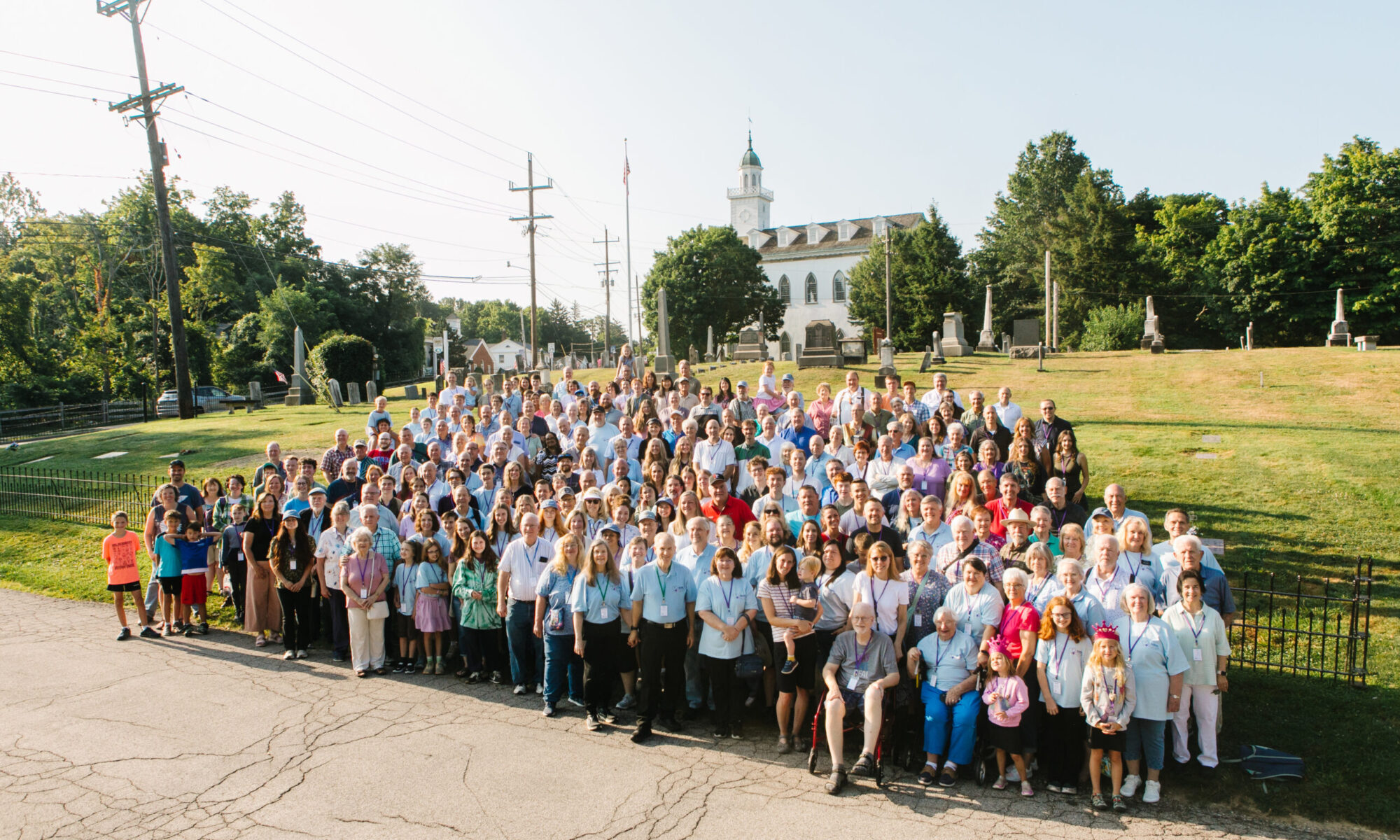

Registration for Joseph’s Miracle Run and the Joseph Smith, Sr and Lucy Mack Smith Reunion are now open. If you register for the race, you will receive a coupon code for a $5.00 discount off your Reunion registration. Just enter the code during checkout.
I Dig Nauvoo
You can help make history in Nauvoo!
May 27 – June 28, 2013
The Joseph Smith Historical Site is sponsoring an archaeological dig at the possible location of the home built for Joseph Smith Sr and Lucy Mack Smith in Nauvoo (south of the Mansion House across Water Street). . Descendants and friends of Joseph Smith Sr. can help literally uncover the Smith family’s roots in Nauvoo. “It’s been many years since we had an active archaeology program in Nauvoo,†says Lachlan MacKay, descendant of Joseph Smith, and Joseph Smith Historic Site Coordinator, “so seeing people excavating brings the research part of the story to life.†All tools and training will be provided.
“It really is a remarkable opportunity to make history in Nauvoo, to connect with your ancestors and dig with your children and grandchildren,†says Bob Smith, one of the hosts for the dig and descendant of Samuel H Smith. The Joseph Smith Sr. Family Association, Samuel H. Smith Foundation, Hyrum Smith Family Association, and Joseph Smith Jr. Historical Society are supporting the dig. MacKay explains, “I’m just incredibly excited to see us working together for this common heritage.â€
Paul DeBar, who has been involved with many digs, including the home of Don Carlos Smith and the Joseph Smith Mansion House, is overseeing the dig. Initial research suggests that the current site is the home where Father Smith called his family to his bedside and gave final blessings to his children before his death in September 1840.
The dig runs Mondays through Fridays, May 27 to June 28, 2013. Dig helpers can register online for a four-hour shift, morning or afternoon. Up to 25 people will be assigned to a team during a shift, so your whole family can work together. “It is a family friendly opportunity,†says Smith.
Participants can also experience history by staying in the Nauvoo House—a dormitory sleeping facility–until June 24, 2013.
For more information on the I Dig Nauvoo project and to register, see www.idignauvoo.org.
Let’s celebrate Katharine Smith Salisbury’s 200th Birthday this Year
By Gracia N. Jones
Katharine Smith Salisbury, born 28 July 1813, in Lebanon, New Hampshire, was 17 when she married Wilkins Jenkins Salisbury, in Kirtland, Ohio 8 January 1831. She died, 2 February 1900, at Fountain Green, Hancock, Illinois. A gravestone for Katharine and her husband stands in the Webster Cemetery in Hancock County.
After the martyrdom of Joseph and Hyrum, and the exodus of the Latter-day Saints to the west, the Salisburys remained in Hancock County. Jenkins died in 1850. Katharine and her family settled at Fountain Green where she had a small farm. In the simmering, politically charged, post-martyrdom atmosphere of Hancock County, they endured much persecution, but Katharine held onto her house and land, and even added to it, using money given her by Brigham Young, with whom she kept up a cordial correspondence up to the time Brigham died. Despite poverty, persecution, and tragedy, Katharine outlived all of her siblings.
Of their eight children, three died young. One daughter, Lucy, married Samuel Duke. Four of her sons grew to adulthood: Solomon, Alvin, Don Carlos, and Frederick. Katharine and Jenkins Salisbury had 23 grandchildren and 46 great grandchildren.
She has numerous posterity, represented by farmers, educators, businessmen, scientists, musicians and artists. In her later years her family always gathered to celebrate her birthday. Nearly every branch of her family has been well represented at the Joseph Smith Sr., Family Reunions since 1972.
Wouldn’t it be wonderful to have a photo display of Katharine and her family? If you can contribute pictures or artifacts for this display, let us know. Visit www.josephsmithsr.org. We hope to have a great crowd to honor this year.
Joseph Smith Jr. Reunion
August 1 – 4 2013, Salt Lake City, Utah
Family Unity Creates a Power and Strength That Makes Even the Impossible Possible
As part of the Joseph Sr. and Lucy Mack Smith family, you are invited to gather in Utah with us and the descendants from each of Joseph Smith Jr.’s brothers and sisters’ families to celebrate our family’s rich ancestry.
Please reserve these dates on your calendar. Reunion details will follow, but feel free to contact Michael and Darcy Kennedy: 801.756.1091 or mkennedey@xmission.com, or Gracia and Ivor Jones: 435.673.2165 or ivorandgracia@gmail.com for more information.
Gift of Gratitude
Joseph Smith Scholarship honoring Dr. Nathan Smith
The year 2013 marks the 200th anniversary of Joseph Smith’s life-threatening typhoid fever and the experimental and successful surgery performed by Dr. Nathan Smith, founder of Dartmouth Medical School (1811). The 1813 surgery blesses millions yet today. As a thank you, the Joseph Smith Sr. Family Association is working to establish a scholarship of gratitude on behalf of Dr. Nathan Smith to the Geisel School of Medicine at Dartmouth Medical College.
Dr. Nathan Smith was the only physician in the United States who had the skill and ability to successfully treat Joseph’s infection. His personal preparation, life’s work, timing, and placement converged to allow Dr. Smith to operate on Joseph, saving his leg and his life, fully 100 years before this life-saving surgery became accepted as standard procedure.
Dr. Smith was one of the great men of the 19th century, who worked tirelessly to improve medical education. He helped establish 4 medical institutions, including Dartmouth and Yale. At the 200th commemoration of the founding of Yale, Dr. William Henry Welch stated that Dr. Smith, “did more for the general advancement of medical and surgical practice than any of his predecessors or contemporaries in this country.â€
To honor Dr. Nathan Smith, the Joseph Smith Sr. Family Association is hosting the Joseph’s Miracle Run to create a scholarship endowment in behalf of Joseph. This annual scholarship will be granted to a deserving medical student at Dartmouth, and will be a reminder of the great good that charitable contributions like Dr. Smith’s can be in the community. To join with us, or to learn more, please visit: www.JosephsMiracleRun.com.
Joseph Sr. and Lucy Mack Smith Largest Reunion Ever!
Register for the Reunion
August 1 – 4, 2013, Salt Lake City, Utah
Help our family set a world record!
- This is the Place Heritage Park.
- Historic buildings to explore.
- Youth & Children’s activities:
panning for gold, pony rides, petting, corral, train rides, etc. - Admission to the park included with reunion registration.
Thursday, August 1 – Registration will be at the University of Utah LDS Institute located at 1780 East South Campus Drive, Salt Lake City, Utah 84112.
Friday, August 2 – Smith Descendant Gatherings
- Strengthen the bonds in smaller family groups.
- See ideas at reunion website.
- Friday night event for the whole family.
Saturday, August 3 – Joseph’s Miracle Run
Our 5K run honors Dr. Nathan Smith, who saved Joseph’s leg from the severe bone infection he suffered when he was just 7 years old. Dr. Smith founded Dartmouth Medical College in Hanover, NH. Proceeds from the run will provide a scholarship in Joseph’s name as a gift of gratitude from our family.
Race registration is already open at www.JosephsMiracleRun.com. What an incredible opportunity to have Joseph’s name be known for good!
The Miracle Run is not just for our family, so invite your neighbors, friends, and associates to participate. There is even an option to not have to run! Think of the legs and feet of your ancestors who have provided you with such a wonderful heritage. It is time to give a payment of gratitude. Participate, invite, and sponsor!
Saturday, August 3 – following Our Family footprints
The hills surrounding This is the Place will help us remember experiences of our Smith ancestors. Did you know that our family traveled nearly 2,000 miles from Palmyra to Harmony, Kirtland and Far West before building beautiful Nauvoo?
Children ages 3 – 11 can participate in group activities to honor Smith family members. Experience walking with crutches like young Joseph, training for Zion’s Camp, and more!
Youth ages 12 – 18 will learn from the Smith’s faith and blessings that followed in a fun morning activity.
Adult meetings will include updates to Smith family research and interesting perspectives surrounding the miracle of Joseph’s leg surgery. We’ll honor descendants of Dr. Nathan Smith and hear from our cousin, Elder M. Russell Ballard.
Sunday, August 4 – Music and the Spoken Word
The family is invited to attend a live broadcast of “Music & the Spoken Word” featuring the Mormon Tabernacle Choir Sunday morning at 9:30 a.m. in the Conference Center. Doors open to the public at 8:30 a.m., guests should be seated by 9:15 a.m., when the doors are closed. The broadcast is 30 minutes in length and ends at 10:00 a.m. Admission is free and limited to those eight years of age and older.
Parking is available in the underground parking at the Conference Center, at no cost.
Stay Connected! Visit today at www.josephsmithsr.org and update your contact information.
Joseph Smith, Sr. Family Association Newsletter – Spring 2013
Upcoming Events
I Dig Nauvoo
May 27 – June 28, 2013
Joseph Smith Sr. & Lucy Mack Smith Reunion
August 1 – 4, 2013
Joseph’s Miracle Run
August 3, 2013
Newsletter Editor
Julie Maddox
jmamaddox@gmail.com
Eldred Smith celebrates 106th birthday
Oldest living Utah man celebrates 106 years
http://www.ksl.com/?nid=148&sid=23684420
SALT LAKE CITY — Most of us have to read about what happened 100 years ago in a history book, but one Utah man has lived it.
Eldred Smith, a Salt Lake City man who celebrated his 106th birthday Wednesday, has a title no one else in the state has: He is oldest man in Utah.
In 1907, doctors performed the first successful blood transfusion and a bouncing baby boy named Eldred G. Smith entered the world. Fast forward more than a century, and Eldred is as sharp as ever — though he does get tired a little faster than he used to.
“What’s your secret to a long life@f0” I asked him, watching his eyes slowly open.
“Getting sleep, apparently,” Eldred said with a laugh.
This great-great-grandfather has lived a lot of life &38212; in years, and experience. During World War II, he worked as an engineer for a company that enriched uranium for the atomic bomb.
He is also the oldest and longest-serving general authority of The Church of Jesus Christ of Latter-day Saints. And his own great-great-grandfather is Hyrum Smith, brother to the founder of The Church of Jesus Christ of Latter-day Saints, Joseph Smith.
Eldred he spent years travelling, displaying church artifacts. KSL caught up with him when he was a spry 100-years-old.
“I tell ’em exercise is a waste of energy,” Eldred said during our 2007 interview. “I use my energy to accomplish something that gives me all the energy I need.”
He has outlived two spouses — his second sweetheart passed away in May 2012, at age 95. But he is still surrounded by his loving children and grandchildren down the line.
“He’s always talked about being around ‘till 110,” said daughter Miriam Skeen. “(He’s) one year closer.”
Eldred celebrated his birthday Wednesday surrounded by family and friends. Among his birthday visitors was LDS Church President Thomas S. Monson, who told Eldred’s family the biggest key to longevity is to just keep breathing.
Jennifer Stagg, Reporter
Joseph’s Miracle Run


August 1-4, 2013 will be our next Joseph Smith Sr. and Lucy Mack Smith Family Reunion. The goal is to have the largest family reunion which according to the Guinness Book of World Records is 2,585. Our family can do it. This reunion will be held in Salt Lake City with the highlight being our opportunity to give back and participate through a fun family experience to honor the work Dr. Nathan Smith. Dr. Smith’s work not only blessed Joseph Smith Jr. but his entire family and the world.
This is why we’re celebrating that miracle with the Joseph’s Miracle Run; to remember Joseph and the great legacy he began. Joseph’s Miracle Run is a 5K race that will be held August 3, 2013, 7:00 am at This Is The Place Heritage Park in Salt Lake City, Utah.
We invite you to join us in supporting this remarkable event. Come run, volunteer, or lend your financial support. If you believe in miracles, if you have been changed because of this young boy, show your appreciation by supporting Joseph’s Miracle Run.
The fundraising will be used to establish an endowment at the Geisel School of Medicine at Dartmouth, which was founded by Nathan Smith. This “Gift of Gratitude” will be made in the name of Joseph Smith, Jr.
For more information, please go to: http://josephsmiraclerun.com.
A Miracle
Dr. Nathan Smith was in the right place, at the right time, with the right experience, and right fortitude.
 This was, after all, 1813, in the most rural area of New Hampshire. The infection in Joseph’s bone (osteomyelitis) followed in the wake of an epidemic of typhoid fever that affected all the Smith children. In those days and up until the discovery of antibiotics in this century, osteomyelitis was a devastating problem. Since the days of Hippocrates of ancient Greece, the standard method of treatment had been the simple application of poultices and plasters to the inflamed flesh. This had little effect: when infection occurs in the bone, long segments of the bony shaft die, and the body, growing new bone, encases the dead material within a living layer. Inevitably, the dead bone separates and lies in the center of an abscess cavity, draining continuously or spreading infection to other parts of the body, resulting in death. Usually in the late stages the leg had to be amputated.
Read the full article written by Dr. Le Roy S. Wirthlin about Nathan Smith here:
https://www.lds.org/ensign/1978/03/discovery?lang=eng